

Q: “Jerry, God gave the land of Israel to the Jewish people as an everlasting possession. Genesis is clear. God doesn’t break His promises. So why do you seem to dismiss that?” – Mike B., New Jersey
A: Mike, let’s go straight to the text you’re likely referring to:
“And I will give to you and to your offspring after you the land of your sojournings, all the land of Canaan, for an everlasting possession (“olam“), and I will be their God.” — Genesis 17:8
That word “everlasting” is the Hebrew word “olam“ (Strong’s H5769).
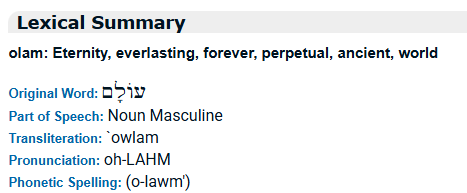
Many Bible versions translate this word as “everlasting,”
However, “olam“ does not automatically mean “eternal without change.” It often means a long duration, an age, or something tied to a covenantal order.
NOTE: To be clear, I am not saying God broke His promise. I am saying Christians have often misunderstood how God fulfills His promises. The New Testament does not teach that God’s promises failed. It teaches that they find their “Yes” in Christ. (1 Cor. 1:20)
Before allowing one English translation of an ancient Hebrew word to carry the weight of modern geopolitics, we can ask how that same word is used elsewhere in the Old Testament.
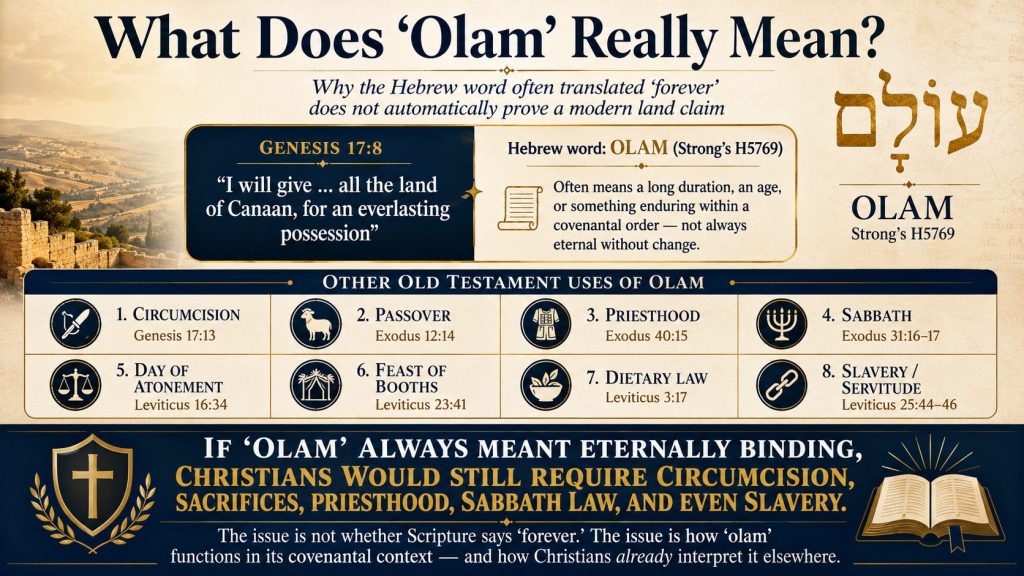
It turns out the exact same word—”olam“—is used all over the Old Testament (438 times to be exact) for things Christians do not believe are still binding today.
Once we see how broadly “olam” is used, the land promise can no longer be isolated from the rest of the Old Testament’s covenant language.
For example, physical circumcision as a sign of God’s covenant is called everlasting (“olam“).
“My covenant shall be in your flesh an everlasting (“olam“) covenant.”
— Genesis 17:13
Do you believe that circumcision of the flesh is a sign of God’s election today?
I’d suspect not. Instead, most Christians would say that physical circumcision was pointing to a spiritual fulfillment in Christ, who circumcises our spiritual hearts.
And what about the Levitical priesthood, which is said to be perpetual (“olam”).
“Their anointing shall admit them to a perpetual (“olam“) priesthood throughout their generations.” — Exodus 40:15
Do you believe that only physical descendants from the ancient tribe of Levi are God’s chosen priests today?
If you’re a Christian, I’d assume you’d believe in something closer to the priesthood of all believers.
So too, keeping the Sabbath laws and regulations is to be forever (“olam”).
“The people of Israel shall keep the Sabbath… as a covenant forever (“olam“).” — Exodus 31:16–17
“Every Sabbath day Aaron shall arrange it before the Lord regularly; it is from the people of Israel as a covenant forever (“olam“).”— Leviticus 24:8
Mike, do you believe all of the Sabbath laws given by Moses are to be observed by God’s people forever (“olam“)?
I’d assume you don’t believe God wants us to sacrifice animals for forgiveness today, right?
Well, that’s a problem, Mike.
Listen to what Leviticus says about the sacrificial system you do not practice:
“The fire shall be kept burning on the altar continually (“olam“); it shall not go out.”
— Leviticus 6:13
Is that fire still burning on the Levitical altar? After all, the Scripture refers to it as “olam.”
And then there’s the Day of Atonement.
“This shall be a statute forever (“olam“) for you, that atonement may be made… once in the year.” — Leviticus 16:34
Using your interpretation of “olam“ here would require us to continue gathering young bulls, rams, male goats, etc in order to keep the Day of Atonement rituals just as God literally gave them to Moses.
After all, the Scripture does say that the statutes surrounding this important feast would last forever (“olam“.)
“It shall be a statute forever (“olam”) throughout your generations.” — Leviticus (multiple passages)
Do you know any Christians who spend even one day a year sacrificing animals and releasing scapegoats into the nearby woods because the Bible said the Day of Atonement was to be forever (“olam“) observed?
And what about the numerous dietary restrictions in the law?
“It shall be a statute forever (“olam“) throughout your generations… that you eat neither fat nor blood.” — Leviticus 3:17
Mike, do you believe that this statute is to last forever (“olam“)? It says it is forever right there in black and white, right?
I could keep going but let’s consider just one final example of “olam” regarding slavery.
“You may buy male and female slaves from among the nations that are around you.… You may bequeath them to your sons after you to inherit as a possession forever (“olam”). — Leviticus 25:44–46
Leviticus 25:44–46 couldn’t be more crystal clear: I suggest you read it in its entirety. Chattel slavery was legal under the Mosaic law and this passage is explicit that God’s people may own human beings as property forever (“olam“).
Mike, do you advocate for the right of God’s people to still be able to buy and own human beings as property as well as the right to give them (and their offspring) as an inheritance to their children forever (“olam“)?
If not, why not?
If Christians already understand that “forever” (“olam“) does not always mean eternally binding in the cases of circumcision, sacrifices, priesthood, Sabbath law, dietary restrictions, and slavery, then why does it suddenly become rigidly literal when the subject is land?
That seems like selective literalism, no?
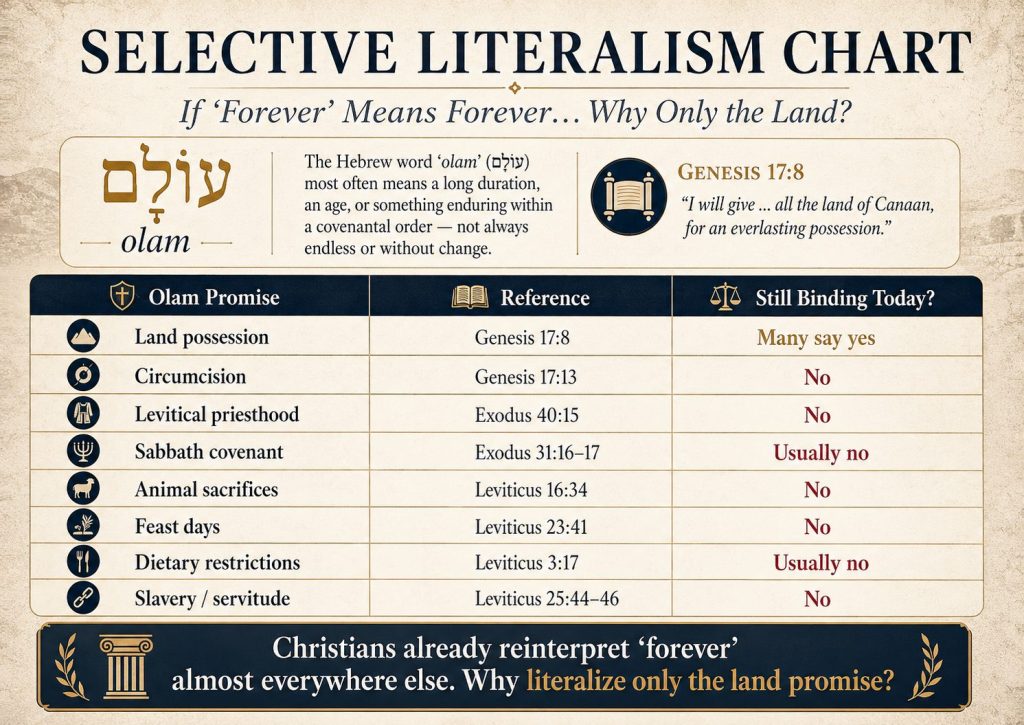
This is the problem. Christians already know how to interpret “forever” through context and fulfillment. The only question is whether they are willing to do it consistently.
I think the pattern is rather obvious. When “olam” points to physical circumcision, physical sacrifice, physical priesthood, physical Sabbath laws, or physical chattel slavery, Christians immediately want to talk about “context,” “a different covenant,” and how those things were “fulfilled in Christ.”
But when “olam” points to physical land, many suddenly become rigid literalists.
Mike, how can we know the right way to interpret “olam” when it comes to the physical land of promise?
It turns out there’s a very simple solution.
Just ask yourself: What did Jesus actually command His followers to do?
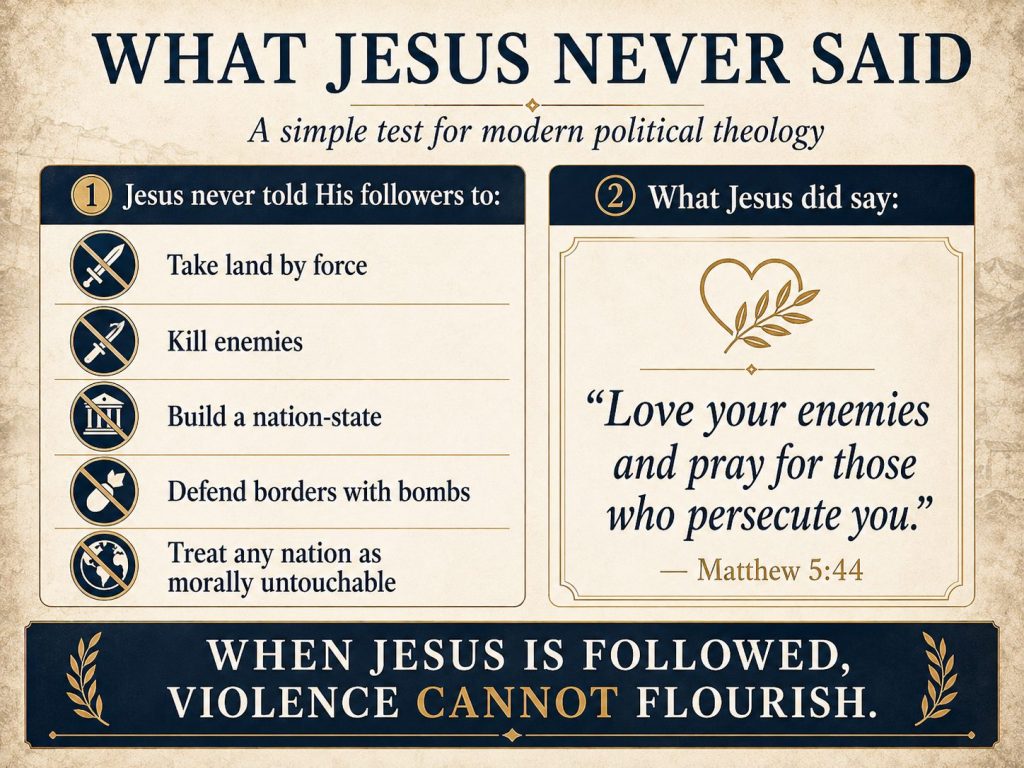
For Christians, this should be the final test. However we understand ancient promises, we cannot use them to override the plain command of Jesus to love our enemies.
So let’s be honest.
You already know that “olam” does not mean eternal and unchanging in every case.
But when it comes to the promise of the physical land, it certainly does in your opinion.
Here’s where we disagree, Mike.
And here’s why:
“For all of God’s promises have been fulfilled in Christ with a resounding “Yes!” — 2 Corinthians 1:20
The New Testament literally says that “all of God’s promises have been fulfilled in Christ.”
God’s promises have not been postponed.
They’ve been fulfilled.
Besides, Jesus never told His followers to secure physical land.
He told them:
“Love your enemies and pray for those who persecute you.” — Matthew 5:44
So, here’s where we likely agree:
We both agree that “olam” doesn’t really mean forever when it comes to physical circumcision.
We agree that “olam” doesn’t mean forever when it comes to physical animal sacrifice.
We agree that “olam” doesn’t mean forever when it comes to owning human beings as property.
But, it appears you believe that “olam” does literally means forever when it comes to physical land.
Mike, I sympathize with you because I used to believe the same thing. Up until around 10-15 years ago, I largely agreed with dispensationalism and Christian Zionism.
But my Biblical and historical research and experiences eventually led me to see how this fascination with a literal promise of physical land had long served to justify genocide, ethnic hatred, and endless religious wars… all under the banner of a divine promise rooted in a cherry-picked interpretation of the Hebrew word “olam.”
Let me say it plainly: If you believe that this word forever (“olam“) requires homicidal violence to uphold it, I believe you’ve misunderstood the promise.
God never breaks His promises. But we can (and do) misunderstand them.
And when we do, we end up defending things Jesus never would.
Blessings,
Jerry Robinson
(TrueRichesAcademy.com)
P.S. Have a comment or a question? Share it below.

Founder of True Riches Academy. Lifelong student of Jesus, writer, and teacher committed to helping believers rediscover the life, teachings, and nonviolent way of Christ through careful, Christ-centered study of Scripture. Author of the forthcoming book The Gospel of Peace: Rediscovering the Nonviolent Way of Jesus.