
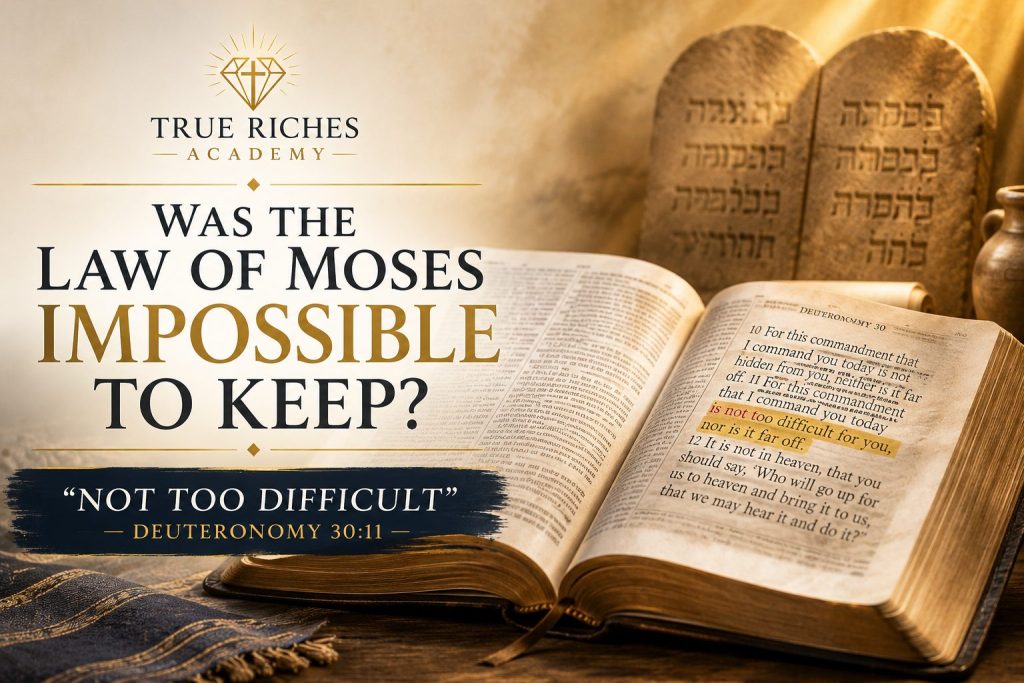
Q: “Hi Jerry, I have heard preachers say my entire life that the Law of Moses was impossible to keep. The usual explanation I’ve heard is that God gave Israel a law that basically guaranteed their failure so that people would eventually understand their need for Jesus. But the Bible describes some people as righteous and blameless under that same law. What am I missing? Thanks in advance for your answer.” – Don H., Montana
Jerry’s Answer: Thanks for the question, Don.
You are not missing anything. The popular claim that the Law of Moses was impossible to keep is repeated constantly in Christian preaching, but the Bible never actually says it.
In fact, Moses said nearly the exact opposite after delivering the law itself:
“For this commandment which I command you today is not too difficult for you, nor is it far away.” Deuteronomy 30:11
A few verses later he continues:
“But the word is very near you, in your mouth and in your heart, that you may observe it.” Deuteronomy 30:14
And then Moses concludes:
“I have set before you life and death, the blessing and the curse. So choose life…” Deuteronomy 30:19
Notice what Moses does not say.
He never tells Israel that God’s commands are impossible to obey. Instead, he repeatedly urges the people to choose life by walking in God’s ways (Deut. 30:15-20; Josh. 24:14-15).
The New Testament gives us another unmistakable example in Zechariah and Elizabeth, the parents of John the Baptist:
“They were both righteous in the sight of God, walking blamelessly in all the commandments and requirements of the Lord.” Luke 1:6
Notice that Luke does not simply say they appeared righteous to other people. They were righteous in the sight of God, and they walked blamelessly in the Lord’s commandments.
Paul used similar language when describing his own life before following Christ:
“As to the righteousness which is in the Law, found blameless.” Philippians 3:6
The Old Testament says similar things about others. Noah was described as “a righteous man, blameless in his generation” (Gen. 6:9). Job was called “blameless and upright” (Job 1:1). King Josiah “did right in the sight of the LORD” (2 Kings 22:2). Scripture repeatedly describes faithful men and women as righteous or blameless before God.
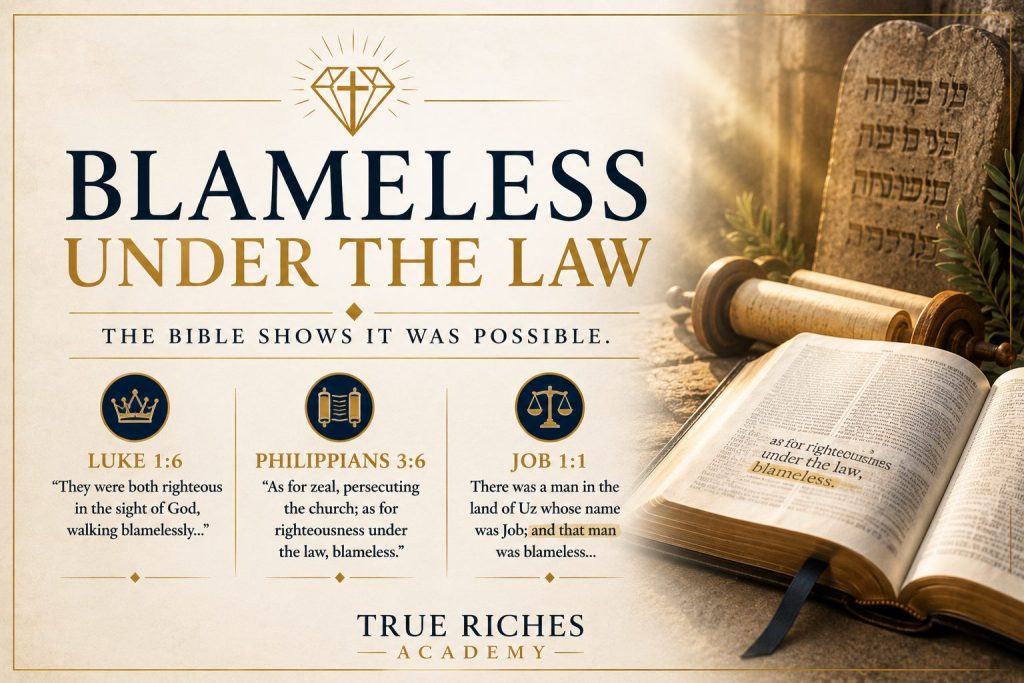
That alone should cause us to reconsider the popular claim that nobody could ever keep the Law of Moses in any meaningful, covenantal sense.
Now, let’s be clear.
“Blameless” does not mean these people never sinned or never made a mistake. The Law itself anticipated human failure and provided a path for confession, restitution, sacrifice, forgiveness, and restoration (Lev. 5:5-6; Lev. 6:1-7; Num. 5:5-8). A person could stumble, seek God’s forgiveness, make things right, and continue walking faithfully within the covenant.
This distinction is important because many Christians redefine “keeping the law” to mean living a perfectly flawless life from birth until death. But that is not how the covenant itself functioned. If one mistake permanently disqualified a person from faithfulness, there would have been no need for sacrifices, restitution, or God’s repeated promises of forgiveness.
So what did Paul mean when he taught that the law could not save?
He did not mean that nobody could obey any of God’s commandments. His argument was much deeper than that. The Law could instruct God’s people, expose sin, restrain evil, and point people toward righteousness, but it could not finally deliver humanity from sin, death, and the power of the flesh (Rom. 8:3-4; Gal. 3:21-22; Heb. 10:1-4).
The Law could shape a covenant people.
But only Christ could make all things new.
We also need to stop assuming that every provision within the Mosaic Law perfectly expressed God’s eternal ideal.
The issue is not whether the law had value. The issue is whether Moses represents the final and fullest revelation of God.
Jesus himself said concerning divorce:
“Because of your hardness of heart Moses permitted you to divorce your wives, but from the beginning it has not been this way.” Matthew 19:8
Jesus distinguished between what Moses said “God literally said” from what God actually intended from the beginning.
Jesus also confronted and rejected the Mosaic law of retaliation:
“You have heard that it was said, ‘An eye for an eye and a tooth for a tooth.’ But I say to you, do not resist an evil person.” Matthew 5:38–39
And He repeatedly reminded His listeners that God desires mercy above religious legalism (Matt. 9:13; Matt. 12:7) while teaching that “the Sabbath was made for man, and not man for the Sabbath” (Mark 2:27).
The real problem, then, was never that the Law of Moses was impossible to keep.
The deeper issue is that the Mosaic covenant was never intended to be God’s final revelation.
Jesus is.
It’s time for Christians to stop repeating the claim that God gave Israel an impossible law and then punished the people for failing to perform the impossible. The biblical evidence simply doesn’t support that conclusion.
Deuteronomy denies it.
Luke denies it.
And Paul’s own testimony denies it.
The Law of Moses could be obeyed covenantally, and Scripture plainly says that some people walked blamelessly within it (Luke 1:6; Phil. 3:6). But the Law could not conquer death, transform the human heart, or reveal the Father as fully as Jesus did (John 1:17-18; Heb. 1:1-3).
As Christians, our goal should not be to force Jesus into a theological system built around Moses.
It should be to understand everything Moses said through Jesus, who is the true and final revelation of the Father.
Blessings,
Jerry Robinson
(TrueRichesAcademy.com)
P.S. What do you think? Does the Bible really teach that the Law of Moses was impossible to keep, or is this one of those traditions we’ve accepted without carefully examining the Scriptures? I’d love to hear your thoughts in the comments below.

Founder of True Riches Academy. Lifelong student of Jesus, writer, and teacher committed to helping believers rediscover the life, teachings, and nonviolent way of Christ through careful, Christ-centered study of Scripture. Author of the forthcoming book The Gospel of Peace: Rediscovering the Nonviolent Way of Jesus.