
Written by Jerry Robinson
Pope Leo XIV recently did something the Christian church should have done far sooner. In his 2026 encyclical Magnifica Humanitas, he acknowledged that the Apostolic See had helped regulate and legitimize forms of subjugation and, in some cases, enslavement. He called this history a “wound in Christian memory” and asked for forgiveness in the name of the Church. The apology is significant, but it also raises a harder question: how did Christians who possessed the teachings of Jesus Christ spend centuries defending the ownership of other human beings as property?
Part of the answer is sitting in plain sight in Leviticus 25.
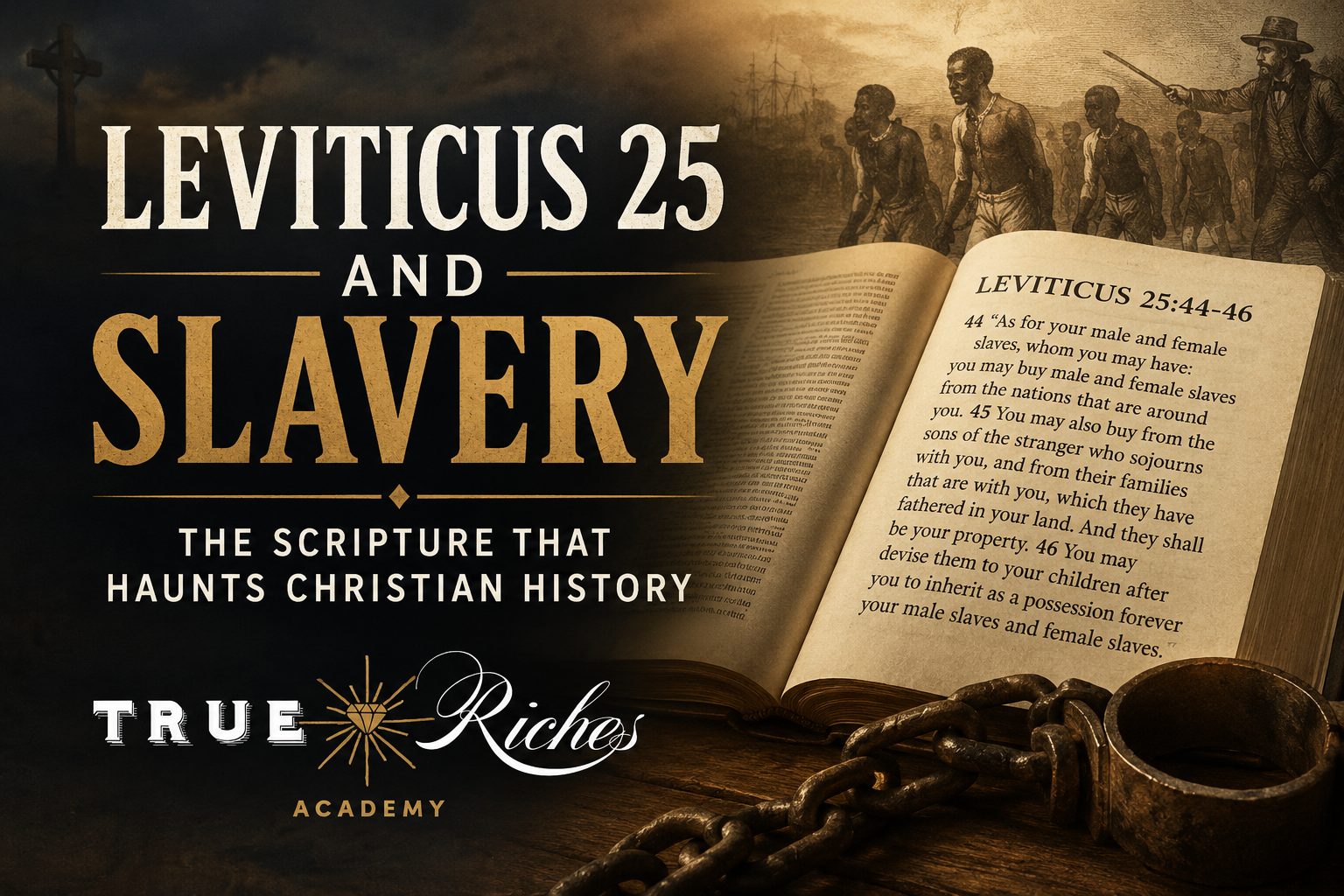
“And as for your male and female slaves whom you may have—from the nations that are around you, from them you may buy male and female slaves. Moreover you may buy the children of the strangers who dwell among you, and their families who are with you, which they beget in your land; and they shall become your property. And you may take them as an inheritance for your children after you, to inherit them as a possession; they shall be your permanent slaves. But regarding your brethren, the children of Israel, you shall not rule over one another with rigor.” (Leviticus 25:44-46 NKJV)
If you think that language is vague, read it again.
Let’s be completely clear. According to the law of Moses, foreigners could be purchased, could “become your property,” could be passed to children as an inheritance, and could remain “permanent slaves.”
In case there is any doubt, that word for “permanent” is the Hebrew word, “olam“ (Strong’s H5769), which is typically translated as “forever” throughout the Torah.
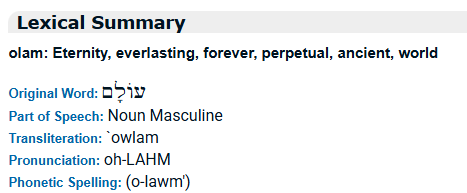
This word “olam” is the same Hebrew word used to proclaim that God is giving the Israelites the land of Canaan “forever.”
Therefore, anyone who believes that God gave the Hebrew people the land of Israel as a possession “forever” (“olam“) because “the Bible says so” must, by the same logic, also believe that God condones these same Hebrew people to own human beings as property “forever” (“olam“).
You can read more about this interesting word “olam” and how it is used in the Old Testament here.
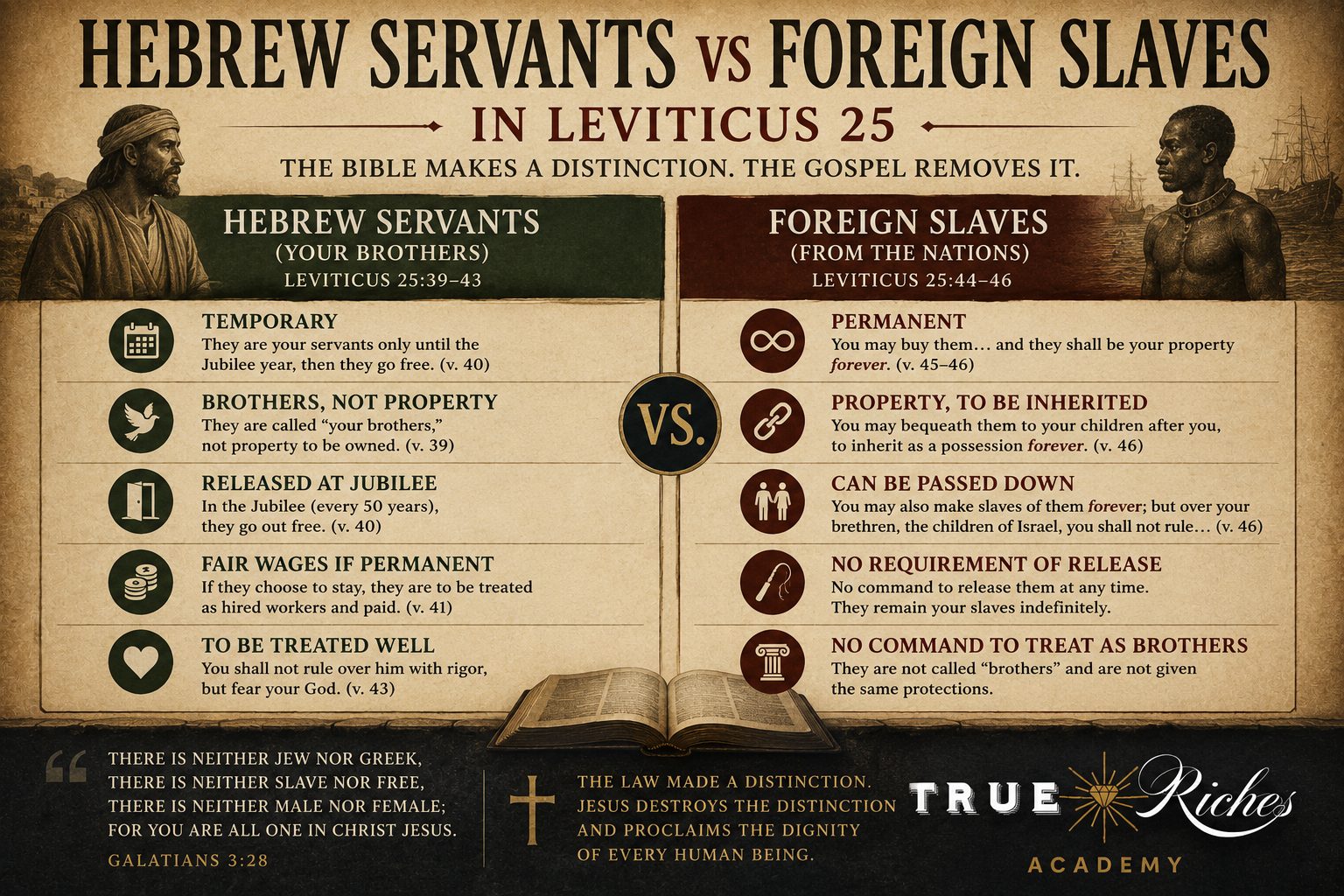
But back to Leviticus 25… Notice earlier in this same chapter, impoverished Hebrews are granted protections that foreign slaves are not given.
“And if one of your brethren who dwells by you becomes poor, and sells himself to you, you shall not compel him to serve as a slave… For they are My servants, whom I brought out of the land of Egypt; they shall not be sold as slaves. You shall not rule over him with rigor, but you shall fear your God.” (Leviticus 25:39, 42-43)
In other words, the Mosaic law prohibited Hebrews from permanently enslaving their fellow Israelites. Foreigners, however, could be bought and owned as permanent property and passed down to their children as an inheritance. This applied to people from the surrounding nations outside Canaan, while the peoples inside Canaan were subjected to the separate conquest commands calling for the destruction of men, women, children, and even animals.
Some may immediately point out that the form of slavery practiced in the ancient Hebrew culture was different than racialized plantation slavery of the American South. However, it is indisputable that ownership of human beings as inheritable property “forever” fits the basic meaning of chattel slavery.
In fact, a very common Christian response upon reading Leviticus 25 is that American slavery was much worse, and in important respects it was. The Transatlantic slave trade was racialized, commercialized on a vast scale, and marked by kidnapping, family separation, sexual violence, forced reproduction, and extraordinary brutality. But notice what that defense concedes. It moves the goalposts from saying the Bible did not permit chattel slavery to arguing that the chattel slavery it permitted was less brutal than ours. This, of course, in no way solves the moral problem.
Jewish interpreters also had to wrestle with this passage. Rabbinic law developed a category for the non-Jewish slave. In America, Rabbi Morris J. Raphall argued in his 1861 sermon The Bible View of Slavery that the Hebrew Scriptures permitted slaveholding, even while saying he personally disliked slavery as practiced. Rabbi David Einhorn answered him publicly and became an outspoken abolitionist. The disagreement itself, however, tells us something important: serious Bible readers knew Leviticus 25 and its endorsement of slavery presented a real problem to the faithful.
American Christian slaveholders certainly knew all about Leviticus 25. In 1822, South Carolina Baptist leader Richard Furman wrote, “The right of holding slaves is clearly established in the Holy Scriptures, both by precept and example.” Furman specifically appealed to Leviticus 25 and then argued that the apostles had converted masters and slaves without commanding emancipation. In 1850, U.S. Senator Jefferson Davis, later president of the Confederacy, said slavery was “established by decree of Almighty God” and “sanctioned in the Bible, in both Testaments.” Presbyterian theologian James Henley Thornwell argued that where Scripture was silent in condemning slavery, the church should “put her hand upon her lips.” American Christianity fractured over the issue. Methodists split in 1844 over slavery, and the Southern Baptist Convention itself later acknowledged that slavery played the primary role in its formation in 1845.
Catholic history contains its own disturbing record. Pope Nicholas V’s 1452 bull Dum Diversas authorized Portugal to conquer certain non-Christian peoples and “reduce their persons to perpetual slavery.” But it wasn’t just Catholic popes that authorized the exploitation and trafficking of human beings as chattel slaves. Catholic orders such as the Jesuits and Protestant institutions like the Church of England owned and operated plantations worked by enslaved people. After baptizing them, they exploited their labor to generate enormous wealth. And it was all done with Biblical support.
The New Testament complicates rather than erases the problem. Of course, Galatians 3:28, the brotherhood language of Philemon, the Golden Rule, and Jesus’ rejection of domination provided powerful seeds that abolitionists would later develop. Yet ,the New Testament never gives the church a general command to abolish slavery or orders Christian masters to emancipate their slaves. Ephesians, Colossians, 1 Timothy, Titus, and 1 Peter instead address slavery as an existing institution, telling slaves to obey or submit while placing moral obligations on masters.
This history should make Christians far more humble when we say, “The Bible clearly says…”
Slaveholders had Bible verses, respected pro-slavery clergy, pro-slavery theological arguments, pro-slavery seminaries, and tons of pro-slavery books that supported their views on chattel slavery.
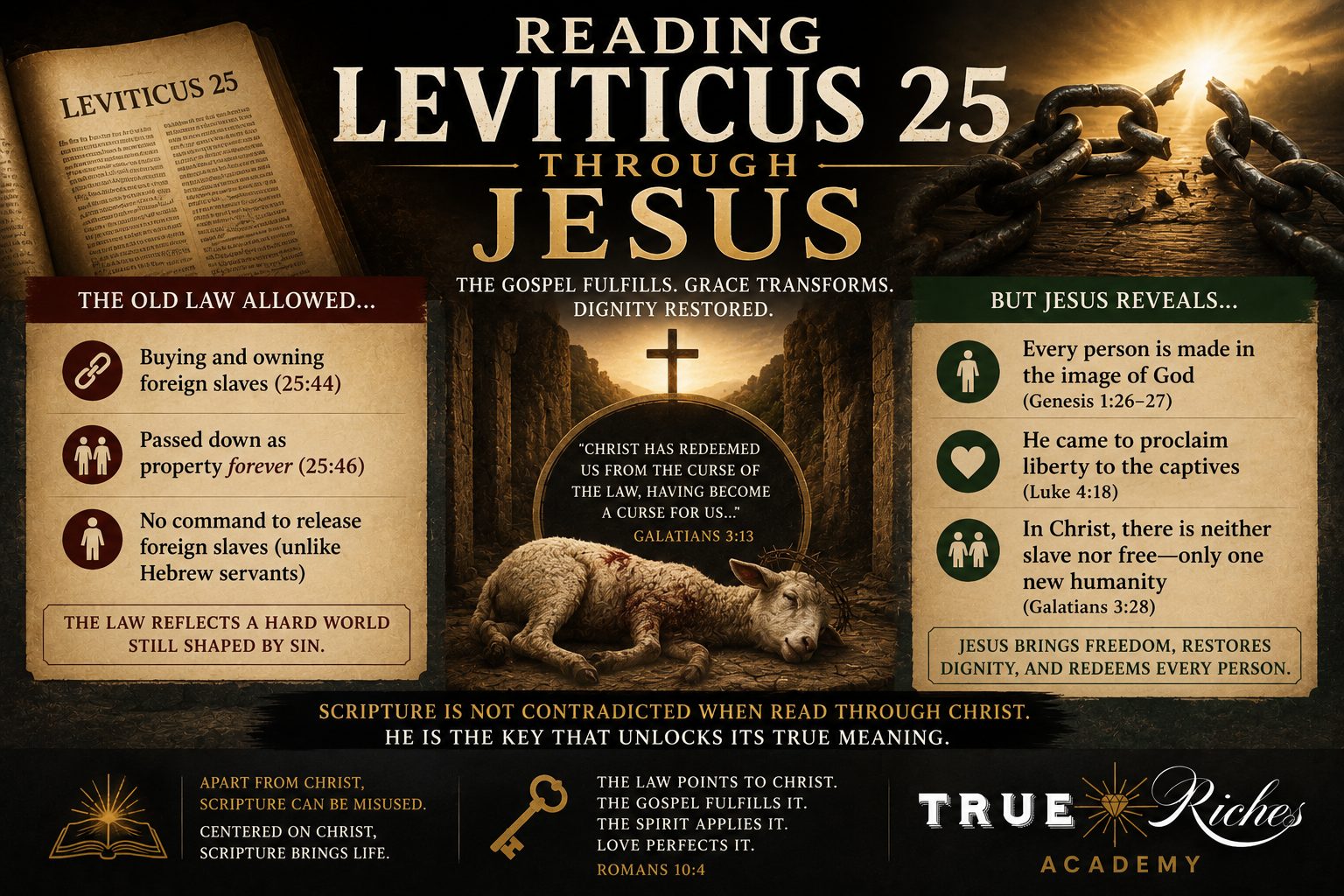
In conclusion, I do not believe that Leviticus 25 should frighten Christians away from Scripture. Instead, it should frighten them away from arrogance about their interpretation of Scripture. I personally believe Jesus must remain the clearest revelation of God for the Christian, and every law, tradition, and theological system must be measured against His life and teaching. The church has been terribly wrong before while quoting the Bible. Remembering that should make Christians slower to baptize violence, domination, nationalism, or exclusion, simply because we can find a text that appears to support it.
TAKEAWAY: Leviticus 25 and slavery belong in the same sentence, whether modern Christians like it or not. In Leviticus 25:44-46, the Old Testament permits Israelites to buy foreign slaves, treat them as property, and pass them down as an inheritance to their children forever (“olam”). Sadly, this is not a minor footnote in Christian history. It is one of the Bible passages slaveholders and many preachers alike used to defend human bondage, and it remains one of the clearest examples of why Christians must learn to read the Old Testament through Jesus.

Founder of True Riches Academy. Lifelong student of Jesus, writer, and teacher committed to helping believers rediscover the life, teachings, and nonviolent way of Christ through careful, Christ-centered study of Scripture. Author of the forthcoming book The Gospel of Peace: Rediscovering the Nonviolent Way of Jesus.