
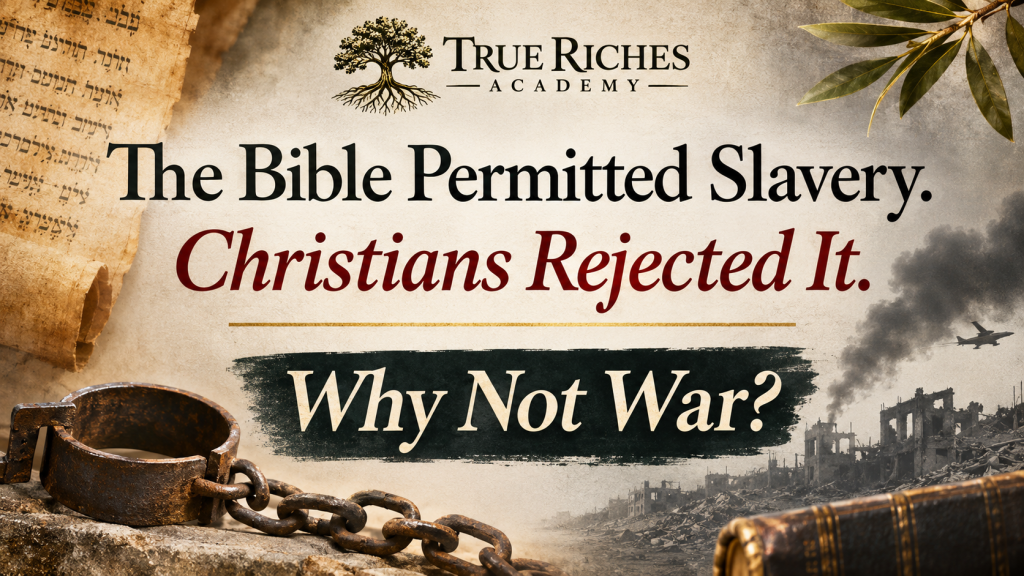
There are many passages in the Bible that I suspect most Christians would rather not think about.
One such verse is Leviticus 25:44–46 where the Israelites are explicitly permitted to buy foreigners as slaves, own them as property, and pass them down to their children as an inheritance. This passage is not describing the hiring of workers or temporary arrangements (i.e. indentured servitude) to pay off debts. Rather, it is condoning the purchase and ownership of fellow human beings as property for life, or “forever” (olam) as the passage says.
And let’s not forget that this permission for the Israelites to own chattel slavery is presented as coming directly from God.
How strange considering that virtually every Christian alive today would agree that owning another human being as property is morally wrong.
This creates an interesting tension of sorts for if the Bible explicitly permits “God’s people” to own humans as property forever, on what basis have Christians (i.e. “God’s people”) decided that they should disallow it?
For centuries, Christians used passages like Leviticus 25 to defend slavery. They also appealed to the New Testament, where slaves are instructed to obey their masters and Paul sends Onesimus back to Philemon, although he urges Philemon to receive him as a beloved brother.
Nowhere, however, does the New Testament explicitly declare that owning another human being as property is inherently immoral, let alone revoke the permission to buy chattel slaves granted by God in Leviticus 25.
Yet Christians eventually helped play a role in dismantling the very same institution that had been given moral cover for centuries by Christians and their Bible.
To be sure, the struggle against slavery began long before the nineteenth century. Christian abolitionists, including Quakers and other reformers, challenged slavery for generations, often facing fierce opposition from fellow Christians who believed the Bible was on their side.
So what changed?
The biblical texts didn’t change. Leviticus 25 still says exactly what it said centuries ago.
May I suggest that what changed was a growing recognition that owning fellow human beings as property is incompatible with Jesus’ teachings of loving neighbors as ourselves.
Once again, how strange considering that Jesus never once delivered a sermon explicitly prohibiting chattel slavery or specifically overturning the permission granted in Leviticus 25.
But Jesus did command to love our neighbors as ourselves, treat others as we would want to be treated, and even extend that same love to enemies. When an expert in the Mosaic law asked him to define the word “neighbor,” Jesus responded with the parable of the Good Samaritan, challenging the religious and social boundaries people used to determine who deserved their concern.
It makes sense that if even my enemy is someone I’m commanded to love as I would love a neighbor, how can I justify owning fellow human beings as property forever?
Jesus compared the kingdom of God to a mustard seed that begins small but eventually grows into something much larger. He also compared it to yeast slowly working its way through an entire batch of dough.
I wonder if something similar is happening in the moral development of humanity.
Jesus planted the seeds of a moral revolution nearly 2,000 years ago. Yet for centuries, Christian societies continued to practice and defend slavery, often with the Bible in hand. Eventually, growing numbers of Christians came to recognize that slavery was incompatible with the very teachings of Jesus they claimed to follow.
Perhaps that’s how spiritual growth works. We don’t always grasp the full implications of what we’ve been taught, and sometimes it takes generations before we’re willing to confront them.
Which brings me to war…
The same Bible that permits slavery also contains passages portraying God commanding warfare, including the destruction of entire enemy populations.
Deuteronomy 20:16–18 is one of the more disturbing examples:
“However, in the cities of the nations the Lord your God is giving you as an inheritance, do not leave alive anything that breathes. Completely destroy them—the Hittites, Amorites, Canaanites, Perizzites, Hivites and Jebusites—as the Lord your God has commanded you. Otherwise, they will teach you to follow all the detestable things they do in worshiping their gods, and you will sin against the Lord your God.”
Yet Jesus commands his followers to love their enemies, bless their persecutors, turn the other cheek, and refuse retaliation. When Peter drew his sword, Jesus tells him to put it away. And when Jesus is crucified, Luke’s Gospel portrays him asking God to forgive the very people responsible for his execution.
If Christians can recognize that owning another human being is morally wrong, despite having express biblical permission to do so, why can’t Christians recognize that killing their enemies is also incompatible with the teachings of Jesus?
Now, I understand the situations aren’t identical. Some Christians argue that war can be necessary to protect innocent people from aggression, and that is a serious moral concern. But it doesn’t settle the question of whether warfare is consistent with the way Jesus commanded his followers to treat their enemies.
War doesn’t simply eliminate military threats. It destroys families, traumatizes children, devastates communities, and often sows the seeds of the very resentments that fuel future conflicts. The people on the receiving end of our bombs are every bit as human as the people dropping them.
And if Jesus commands us to love even those who hate us, shouldn’t that teaching have something profound to say about the way we respond to our nation’s enemies?
I believe Christianity’s long struggle with slavery offers an important lesson. We have already demonstrated that we can recognize the moral inadequacy of a practice explicitly permitted in Scripture by taking the broader teachings of Jesus seriously.
I hope we eventually apply that same moral reasoning to war.
One day, I hope humanity looks back on war the way we now look back on chattel slavery, wondering how so many otherwise decent and religious people convinced themselves that such widespread suffering and destruction were morally necessary.
For centuries, Christians defended slavery with Bible verses. Today, we reject the institution those verses permitted. I believe the same awakening is possible with war, not by pretending the troubling biblical passages don’t exist, but by recognizing that the implications of Jesus’ teachings reach further than previous generations were willing to acknowledge.
God hasn’t changed His mind about loving enemies. But maybe we’re finally beginning to change ours.
And perhaps the next great chapter in Christian history won’t be written by those who discover new reasons to defend the violence of the past, but by those who finally take seriously the enemy-loving Jesus.

Founder of True Riches Academy. Lifelong student of Jesus, writer, and teacher committed to helping believers rediscover the life, teachings, and nonviolent way of Christ through careful, Christ-centered study of Scripture. Author of the forthcoming book The Gospel of Peace: Rediscovering the Nonviolent Way of Jesus.